European 4-in-1
How the European 4-in-1 weave is built, which ring sizes and aspect ratios work, why it is the standard starter weave, and the mistakes that make a first sheet pucker.
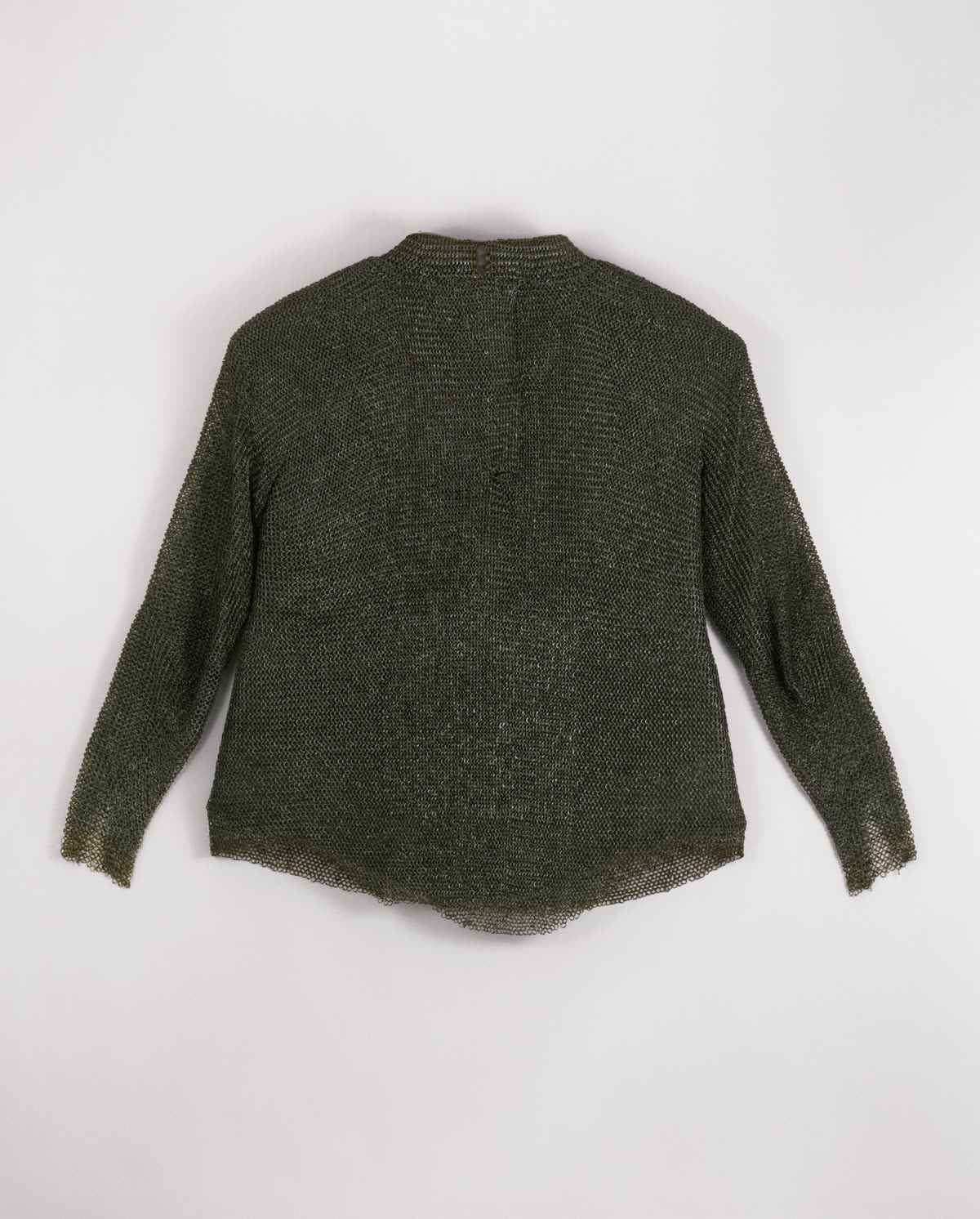
European 4-in-1 is the pattern behind most of the mail in museum cases and most of the chainmail made today. Every ring passes through four neighbours, two in the row above and two in the row below, and the whole sheet is built from that one repeated move. If you can make a single row of it, you can make a shirt. The only things that change are how many rings you use and how big they are.
How the pattern is built
Start with one closed ring. Thread four open rings through it, two on each side, then close them. Those four rings become the first row of the next course, and each pair of them takes two more rings. In practice you work in rows: close a ring, add two, close the next ring and add the next pair so that every ring on the new row shares two links with the previous row.
Orientation matters more than anything else. Rings in a row sit in alternating directions, one tilted up and the next tilted down, so that the rings in the next row can drop through the gaps. When a sheet looks lumpy or one edge curls, it is nearly always because a row got twisted and two neighbouring rings are leaning the same way.
Because every ring links four others, the sheet is flexible in both directions and drapes like coarse fabric. It holds its shape well, which is why historic hauberks, coifs and sleeves all used it.
Which ring sizes work
The number to watch is the aspect ratio, inside diameter divided by wire diameter. Aspect ratio explained covers the maths. For European 4-in-1 the practical range is wider than for most weaves:
| Aspect ratio | What you get |
|---|---|
| Below about 3.0 | Rings jam. Four rings will not fit through one, or only by forcing them. |
| 3.0 to 3.5 | Dense, stiff, heavy mail. Good for armour feel, hard on the hands. |
| 3.5 to 4.5 | The comfortable range. Flexible, easy to assemble, drapes well. |
| Above 5.0 | Loose and open. Lighter, but it stretches and gaps show. |
As a concrete example, 16 SWG wire (1.63 mm) with a 5/16 inch inside diameter works out to an aspect ratio of about 4.9, which is loose but easy. The same wire at 1/4 inch gives 3.9, which most people find the sweet spot for a first project. A common beginner jewellery size is 18 SWG (1.22 mm) at 3/16 inch, also 3.9.
These ranges are approximate. Soft aluminum wire tolerates a tighter ratio than stiff steel because you can flex the rings, and the way you close rings changes how much room is left inside them. Make a 3 by 3 inch swatch before you commit to a thousand rings.
What you need
- Two pairs of smooth-jawed flat nose pliers, so you can open one ring and hold the next.
- Enough rings for the project. A bracelet about seven inches long and an inch and a half wide takes roughly 150 to 250 rings at the sizes above.
- A clasp, if you are making jewellery, or a finished edge if you are not.
The tools guide lists what to buy and what to skip. For a first project see the bracelet walkthrough.
Mistakes that cost the most time
Closing rings with a gap. An open seam is where a ring fails. Close each ring until the two ends meet with no light between them. See how to open and close jump rings.
Mixing ring sizes by accident. A bag of rings that looks uniform often contains batches that differ by a tenth of a millimetre, enough to change the aspect ratio. Work from one batch.
Pulling rings apart sideways. Open a ring by twisting the ends in opposite directions like a door hinge. Pulling the ends apart bends the ring out of round and it never closes cleanly again.
Building a wide piece in one go. Wide pieces are easier as two or three narrow strips joined afterwards.
Where to go next
If European 4-in-1 feels routine, the Byzantine weave makes a chain-like rope with the same tools, and the weave comparison shows how the main patterns differ in ring count, flexibility and difficulty.
Questions
Is European 4-in-1 the same as chainmail?
It is the most common chainmail weave, and when someone says chainmail without naming a pattern they usually mean this one. Other weaves are also mail, they just link the rings differently.
How many rings do I need per square inch?
It depends on ring size. Make a small swatch, count the rings in a known area, and multiply. Your own swatch is more reliable than any table.
Why does my sheet curl?
Almost always one row where the rings were all tilted the same way. Take the row out and rebuild it, alternating the direction of every ring.