Japanese 6-in-1
An explanation of the Japanese 6-in-1 style of mail, where each ring links six others, how it differs from 4-in-1, what ring sizes it needs and when it is the right choice.
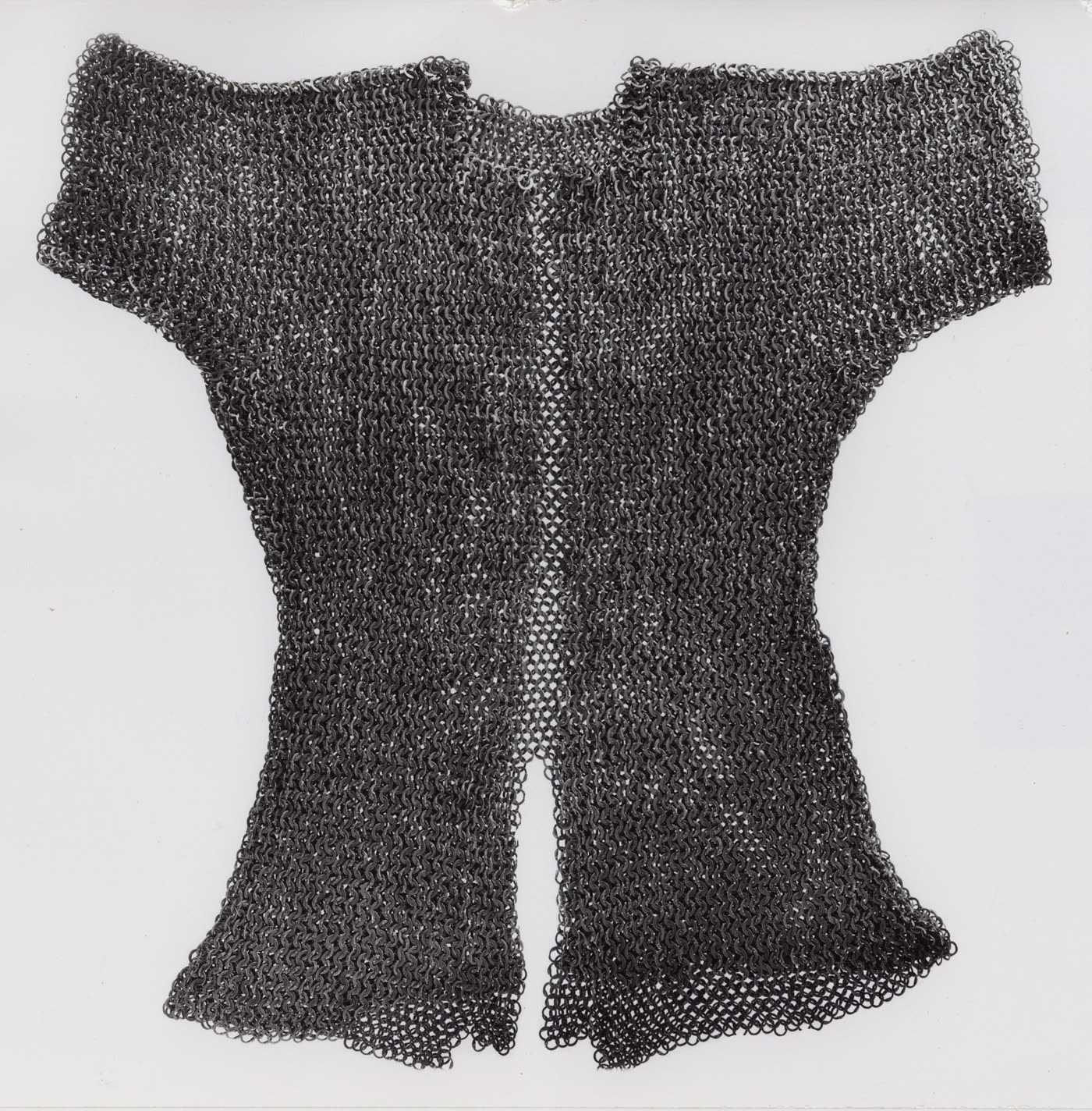
Japanese armour makers used mail, called kusari, in sleeves, collars, gloves and linings under plates. They used more than one linking pattern. Alongside the familiar 4-in-1, which looks like European mail, surviving pieces show patterns where each ring is linked to six neighbours. Hobby makers call the six-link version Japanese 6-in-1, and some use the name for related patterns too, so check the diagram before you trust a tutorial title.
What six links change
In 4-in-1 each ring has four neighbours and the rings sit in a square-ish lattice. In 6-in-1 each ring has six neighbours, arranged around it in a hexagon. Six links per ring means:
- Smaller gaps. The sheet is dense. It is harder to push a thin object, such as a fingertip or a pin, through it.
- More rings per square inch. Each ring does more work, but you need more of them, so projects are slower and heavier.
- Less stretch. The hexagonal arrangement spreads load in more directions.
- A different drape. The sheet feels firmer and a little more like cloth.
Because the weave is dense, it appears where a maker needed coverage in a small area, such as sleeves and gauntlets. Count rings in a swatch of the sizes you pick to compare the ring cost against 4-in-1 before you start.
Aspect ratio and ring sizes
Six links through a single ring demand room. The inside of each ring has to pass several wires, so the usable aspect ratio starts higher than for 4-in-1. Many makers start at 4.0 and go up to around 5.5, using thinner wire or a larger inside diameter than they would for European 4-in-1 in the same project.
| Wire | Inside diameter | Aspect ratio |
|---|---|---|
| 18 SWG (1.22 mm) | 1/4 in (6.35 mm) | 5.2 |
| 20 SWG (0.91 mm) | 3/16 in (4.76 mm) | 5.2 |
| 20 SWG (0.91 mm) | 5/32 in (3.97 mm) | 4.3 |
| 16 SWG (1.63 mm) | 5/16 in (7.94 mm) | 4.9 |
Check these with the aspect ratio calculator. If the sheet will not close up, the ratio is too low. If it gapes, it is too high.
When it is the right choice
Choose 6-in-1 when you want a dense, firm sheet that stays closed under flexing: sleeves, wrist guards, a collar, or a tight cuff. Choose European 4-in-1 for anything that should drape and move freely, such as a long shirt or a scarf. Choose Byzantine for chains.
Working method
Hexagonal weaves are assembled in rows like 4-in-1, but each new ring passes through more rings of the previous row. Keep rings oriented the same way throughout and close every ring completely, because every ring carries six connections and a failure shows quickly. Work in good light with a contrasting surface under the work. Start with a patch about two inches square and check that the pattern is regular before extending it.
The tools are the same as for other weaves: two pairs of smooth flat nose pliers. See the tools guide.
Questions
Is Japanese 6-in-1 stronger than European 4-in-1?
It is denser and holds its shape better under flexing, but strength in armour depends on the wire, on the rings being closed or riveted, and on the padding underneath. A tighter weave is not automatically more protective.
Why do tutorials disagree on the name?
Hobby names for hexagonal patterns are not standardised. Compare how many links each ring has, not the title.
Can I make it in aluminum?
Yes. Aluminum keeps a large sleeve or panel light. Expect to use more rings for the same area than for 4-in-1.