Rings in a chainmail shirt
A realistic guide to ring counts, weight and build time for a chainmail shirt, with a swatch method to work out your own numbers for any ring size and metal.
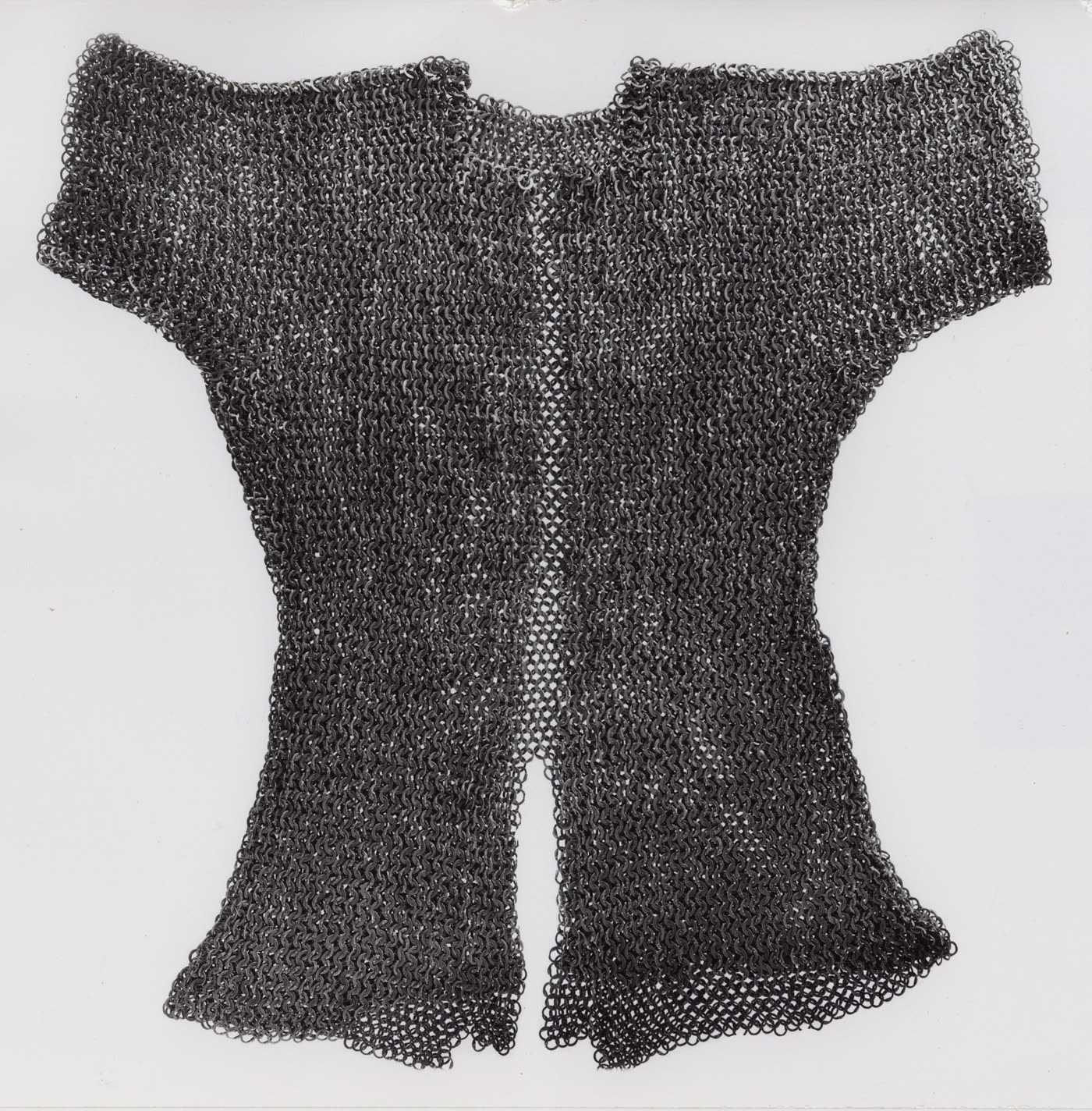
People ask this before starting a shirt because the answer decides whether the project is a month or a year. The honest answer is a range, because ring size drives everything. The good news is you can work out your own number with a swatch and a ruler.
The usual figures
Commonly cited figures for a historic hauberk run from roughly 20,000 to 40,000 rings, depending on how long the shirt is, whether it has sleeves, and how small the rings are. Museum shirts built from small rings sit at the top of that range. Modern reproduction shirts in 16 SWG with a 5/16 inch inside diameter use fewer, larger rings and weigh more.
Weight depends on metal as much as ring count. A steel shirt of the size reenactors wear is often described as weighing in the region of 20 to 30 pounds. The same pattern in aluminum comes in at around a third of that, because aluminum is about a third of the density of steel. See metals compared.
Do your own estimate
Do not trust a table. Measure.
- Make a swatch. Build a flat piece of European 4-in-1 about 3 by 3 inches in the ring size you plan to use. See the weave guide.
- Count the rings. Count every ring in the swatch.
- Divide by the area. Rings per square inch is the count divided by the swatch area, 9 for a 3 by 3 inch piece.
- Work out the area of the garment. For a simple shirt: front and back are each width by length, plus sleeves. A shirt 22 inches wide and 30 inches long needs about 1,320 square inches for front and back together. Add sleeves, for example two sleeves of 10 by 24 inches, another 480.
- Multiply. Total area times rings per square inch gives the ring count.
- Add 10 percent for waste, failed rings and shaping at the neck and underarms.
Use the same approach for weight. Weigh the swatch, divide by its area, and multiply by the garment area.
Ring size effect
Ring density rises sharply as rings get smaller. Halving the inside diameter roughly quadruples the ring count for the same area. That is the reason fine, thin-wire mail takes so long. Choose the ring size from the aspect ratio you want, then look at the project size.
A practical compromise for a first full shirt is 16 SWG rings with an inside diameter of 5/16 inch, aluminum. It is light, goes quickly and gives an aspect ratio near 4.9, loose but easy.
Time
A fast, experienced maker can close and assemble a few hundred rings an hour in simple 4-in-1. A beginner will manage far fewer at first. A 25,000-ring shirt at 200 rings an hour is 125 hours. Plan for more.
Cost
Ring cost scales with weight. Pound for pound, aluminum rings cost less than steel, and larger, thicker rings cost less per ring than small ones. Add pliers, a work mat and a few spare bags of rings. See the tools guide.
Ways to reduce the work
- Make a chainmail coif or a sleeve first and wear it.
- Use larger rings, which cover area faster.
- Make a vest or tabard instead of a full shirt.
- Split the build into strips and join them.
If you are decorating a smaller project such as a pouch, scales cover area with far fewer pieces. See the scale mail calculator.
Questions
Is a chainmail shirt heavy to wear?
A steel shirt is noticeably heavy, mostly on the shoulders, and belts or padding help spread the load. Aluminum is light enough to wear all day.
How long does a shirt take?
Many makers report hundreds of hours. Plan it as a long project.
Does a longer shirt double the ring count?
Roughly, yes. Ring count follows area, so a hip-length shirt uses much less than a knee-length one.